Let's discuss your requirements, please fill in the form below
Let's discuss your requirements, please fill in the form below
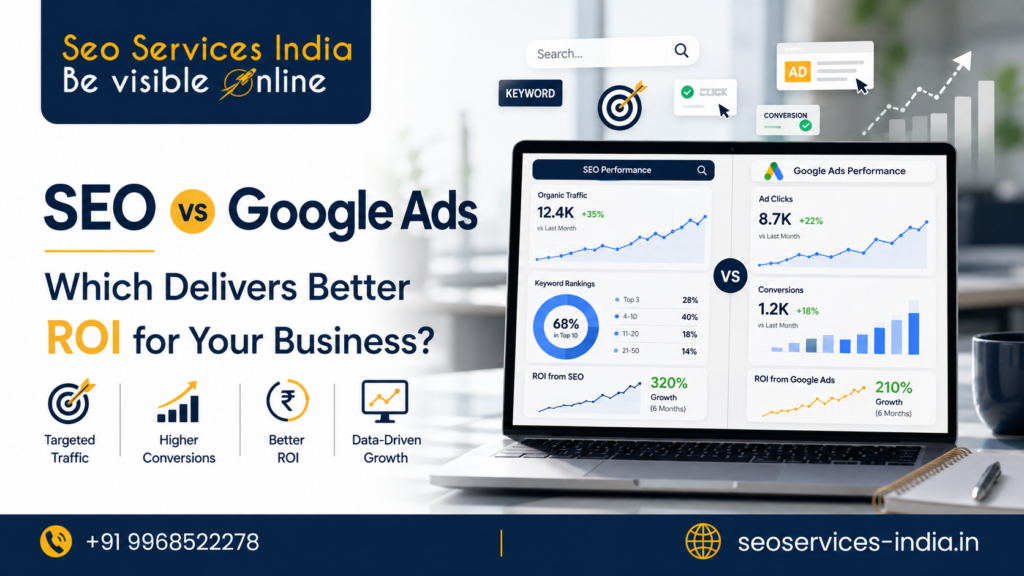
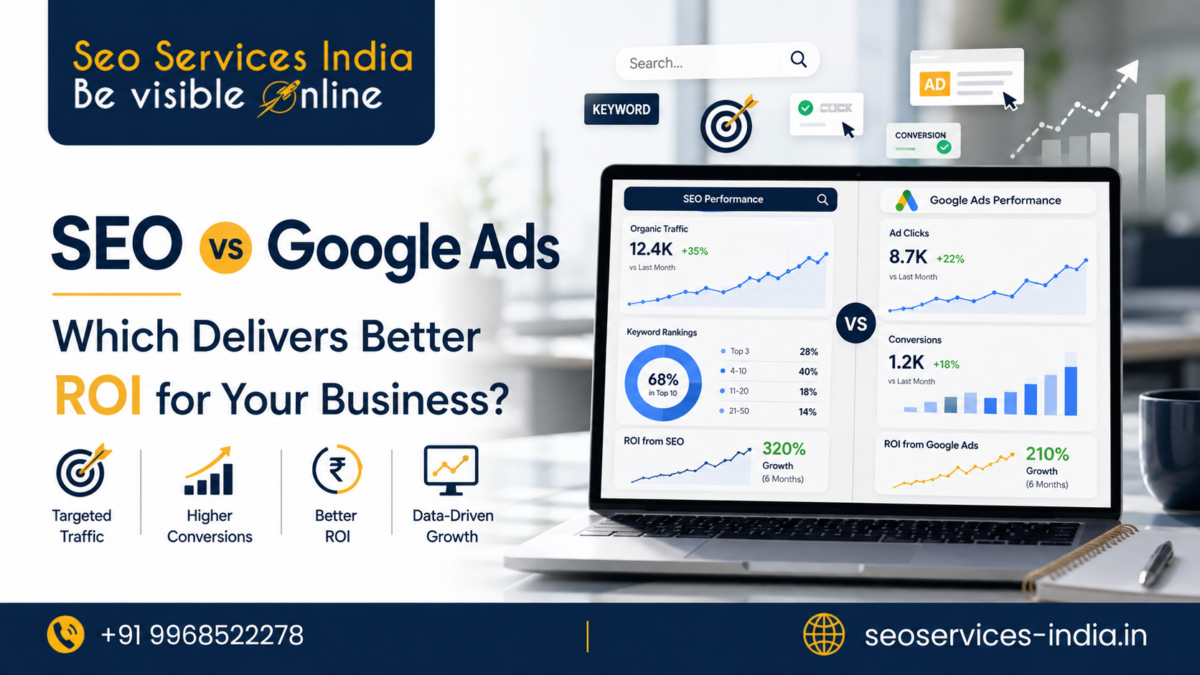
Two choices businesses typically consider when seeking to bring in more visitors online are search engine optimization (SEO) and Google Ads. While both can help drive traffic to your website, increase leads and contribute to your business growth, they operate very differently. Knowing the difference between SEO and Google Ads can guide businesses in determining how to allocate their marketing resources.
SEO is about optimizing a website to appear in search engine results naturally, whereas Google Ads is about advertising on Google that requires a fee. The key is to consider various factors like budget, business objectives, competition, and the speed of results.
Knowing how to use SEO and Google Adwords.
SEO is a long-term digital marketing tactic that aims to boost a website’s natural search engine results. This includes activities like keyword research, content optimization, technical SEO, link building, and enhancing the overall user experience.
The most significant benefit is that websites can continue to generate traffic without paying for each click as a result of SEO. Generally, it will take time, regular work, and content of good quality to achieve good rankings.
Google Ads is different. Businesses develop paid search campaigns that enable the display of their ads for specific keywords. Advertisers are typically paid upon click-through.
Google Ads may be handy for businesses that need to see traffic fast after launching a new campaign, as it can start driving traffic soon afterward.
There is no one right or wrong answer when it comes to making an SEO vs Google Ads decision. The ROI of a campaign is dependent on the situation, the target market, the competition for the keywords, the conversion rate, and the goal of the marketing campaign.
The benefit of SEO is that you don’t have to pay each visitor that comes through your site, so you can enjoy great long-term ROI. A website that establishes valuable rankings can continue to draw in potential customers in the future.
But SEO takes an initial investment of strategy, content, technical enhancements, and authority building. It can take months to get results, particularly in competitive industries.
Google Ads, on the other hand, provides more immediate visibility. It allows a business to deliver users precisely to the landing page that is likely to meet their needs if they are searching for a product or service with high intent. This is often advantageous when a business is looking for immediate leads, sales or website traffic – which is why paid advertising can be quite helpful.
The challenge is that the traffic generally stops when the advertising budget stops. So it is very important for businesses to keep a close eye on the performance of campaigns, to ensure that the revenue earned is commensurate with the advertising costs.
For businesses that are looking to grow sustainably, SEO can make for good business choices. By continually improving their website and creating valuable content, businesses can enhance their online presence and gain a competitive advantage.
A local service provider can, for instance, develop web pages for certain services and locations. These pages can draw in organic traffic over the years.
Also, businesses that want to become authorities in their particular field can benefit from SEO. Useful guides, informative blog posts, optimized service pages and trustworthy backlinks can enhance a website’s search presence as a whole.
SEO takes a little longer to yield results, but it can also pay off in the long run.
In some cases, Google Ads may be better.
Google Ads can be particularly beneficial if fast traffic or immediate results are important. Paid search can be a good option for businesses looking to quickly establish visibility when they are launching a new product, promoting a limited-time offer, or entering a competitive market.
Targeting is another benefit. Advertisers can select keywords and locations, audiences, budget, campaign settings and more to target potential customers more accurately.
For instance, if your company provides emergency services, they are more likely to show up in the search results when someone is looking for an urgent solution. In those cases, it may be impractical to wait for months for the rankings to come back on organic search.
But Google Ads campaigns need monitoring on a continuous basis. Using the wrong keywords, landing pages that don’t match the search intent, or overspending can lead to lower profitability.
Many businesses can enjoy the advantages of both SEO and Google Ads, but not necessarily one at a time.
Google Ads can deliver instant traffic, while SEO will help to drive organic traffic in the long run. PPC campaigns can also offer some valuable data on keyword effectiveness, user behaviour and conversion rates which can be used to guide an SEO campaign.
For example, Google Ads can help a business to find out which keywords are generating conversions. The highest converting keywords can then be used for SEO content and landing pages.
This is because it allows for a balanced approach between paid advertising and SEO, with the goal of paid ads being to serve as a bridge to achieve short-term results while SEO is executed for long-term, sustainable organic growth.
When it comes to the question of SEO or Google Ads, it should be more than just about cost effectiveness or time efficiency. Google Ads can offer instant visibility and targeted traffic, while SEO can build up organic traffic over time and potentially lead to higher long-term returns.
Combining both is best suited for many businesses. SEO can establish a long-term sustainable online presence and Google Ads can provide quick opportunities and test market demand.